What this National Insurance calculator does
This National Insurance calculator shows how much NI you’ll pay in the 2026/27 tax year, which runs from 6 April 2026 to 5 April 2027. First, enter your pay (or your profits if you’re self-employed). The calculator then works out your National Insurance per year, month and week, with a band-by-band breakdown so you can see exactly where the figure comes from.
If you’re an employee, it also shows how much employer’s National Insurance your boss pays on top of your salary. Unlike Income Tax, National Insurance rates are the same in England, Scotland, Wales and Northern Ireland, so this calculator works wherever you live in the UK.
How to use the National Insurance calculator
- Choose who you are. Pick “An employee (PAYE)” if you get a payslip, or “Self-employed” if you’re a sole trader and fill in a Self Assessment tax return.
- Enter your earnings. Employees enter gross pay before tax. If you pay into a pension through salary sacrifice, use the figure after the sacrifice. Self-employed people enter their yearly taxable profit (income minus allowable expenses).
- Pick the pay period (employees). Choose year, month or week. Payroll works out NI separately for each pay period, so entering your monthly pay gives a closer match to your payslip.
- Choose your NI category letter (employees). You’ll find it on your payslip. Most people are category A.
- Tick the options that apply (self-employed). Choose voluntary Class 2 if your profits are under £7,105 and you want the year to count towards your State Pension, or tick the State Pension age box if it applies.
- Press Calculate. The results update straight away. Use Reset to go back to the example figures.
How to work out National Insurance
You don’t pay National Insurance on all of your pay. Instead, you only pay it on the slice of earnings between certain limits. In addition, the rate drops once you earn above the top limit. For a category A employee in 2026/27 the formula is:
Employee NI = (pay between £12,570 and £50,270 × 8%) + (pay above £50,270 × 2%)
Similarly, Class 4 NI for the self-employed works the same way, although the rates are lower:
Class 4 NI = (profits between £12,570 and £50,270 × 6%) + (profits above £50,270 × 2%)
Here’s what each term means:
- Primary Threshold (PT): the point where employees start paying NI. It’s £12,570 a year, £1,048 a month or £242 a week.
- Upper Earnings Limit (UEL): above this, the employee rate falls from 8% to 2%. It’s £50,270 a year, £4,189 a month or £967 a week.
- Lower Earnings Limit (LEL): £129 a week (£6,708 a year). You pay nothing between the LEL and the PT. However, earning at least this much still builds your NI record for the State Pension.
- Secondary Threshold (ST): the point where your employer starts paying NI on your wages. It’s £5,000 a year, £417 a month or £96 a week.
- Lower and Upper Profits Limits: the self-employed equivalents of the PT and UEL, at £12,570 and £50,270.
In practice, most employers use HMRC’s “exact percentage” method and round each calculation to the nearest penny (HMRC National Insurance Manual NIM11002). This calculator therefore does the same.
Worked examples
Employee earning £35,000 a year
| Step | Working | Amount |
|---|---|---|
| Gross pay | £35,000.00 | |
| Pay in the 8% band | £35,000 − £12,570 | £22,430.00 |
| Employee NI | £22,430 × 8% | £1,794.40 |
| Pay above £50,270 | None | £0.00 |
| Total employee NI | £1,794.40 a year |
That’s about £149.53 a month, or 5.13% of the whole salary. In addition, the employer pays a further £4,500 in employer’s NI: (£35,000 − £5,000) × 15%. That doesn’t come out of your pay. Even so, it’s part of what it costs to employ you.
Employee paid £3,000 a month
Monthly NI is (£3,000 − £1,048) × 8% = £156.16. As a result, over 12 months you pay £1,873.92. By contrast, if you put £36,000 in as a yearly figure instead, you’d get £1,874.40. The 48p gap appears because HMRC rounds the monthly thresholds to whole pounds. That’s why entering the amount you’re actually paid each period gets you closest to your payslip.
Self-employed with £35,000 profit
Class 4 NI is (£35,000 − £12,570) × 6% = £1,345.80 for the year. Because your profits are above the £7,105 Small Profits Threshold, you get a qualifying year for your State Pension without paying any Class 2. You then pay it through your Self Assessment tax return, along with your Income Tax.
High earner on £80,000
An employee pays £3,016.00 on the slice from £12,570 to £50,270 (£37,700 × 8%), plus £594.60 on the £29,730 above it (2%), making £3,610.60. By comparison, a self-employed person with £80,000 profit pays £2,262.00 + £594.60 = £2,856.60 in Class 4.
National Insurance rates and thresholds 2026/27
All of these figures come from HMRC’s rates and allowances for National Insurance contributions and rates and thresholds for employers 2026 to 2027.
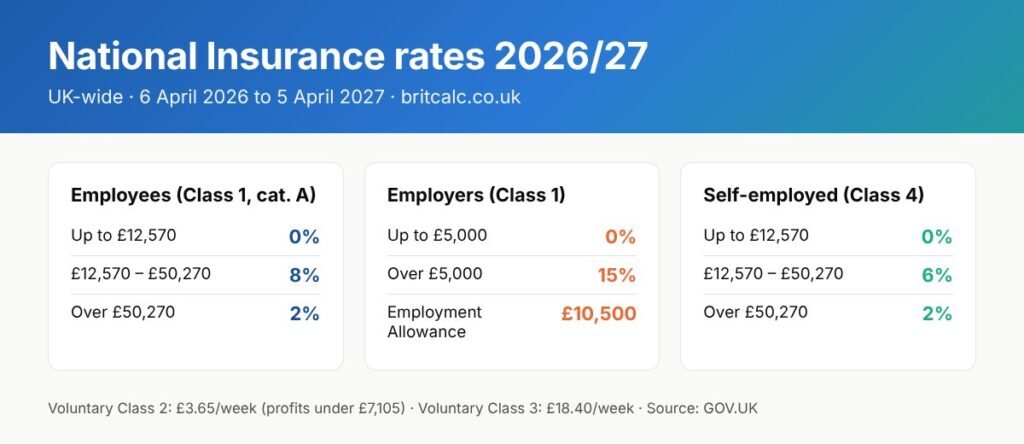
Class 1 thresholds (employees and employers)
| Threshold | Weekly | Monthly | Yearly |
|---|---|---|---|
| Lower Earnings Limit (LEL) | £129 | £559 | £6,708 |
| Secondary Threshold (ST, employer) | £96 | £417 | £5,000 |
| Primary Threshold (PT, employee) | £242 | £1,048 | £12,570 |
| Upper Earnings Limit (UEL) | £967 | £4,189 | £50,270 |
| Upper Secondary Threshold (under 21s), apprentice and veterans thresholds | £967 | £4,189 | £50,270 |
Class 1 rates
| Who pays | Rate |
|---|---|
| Employee, between PT and UEL (category A) | 8% |
| Employee, above UEL | 2% |
| Employer, above Secondary Threshold | 15% |
Self-employed and voluntary rates
| Class | 2026/27 rate |
|---|---|
| Class 4, profits £12,570 to £50,270 | 6% |
| Class 4, profits above £50,270 | 2% |
| Class 2 (voluntary, profits under £7,105) | £3.65 a week (£189.80 a year) |
| Class 3 (voluntary, to fill gaps in your record) | £18.40 a week |
The government has frozen the main thresholds. As a result, they’re the same as in 2025/26. The government has set the Primary Threshold and Upper Earnings Limit at these levels until at least 5 April 2028. On the other hand, the Lower Earnings Limit, Small Profits Threshold and voluntary rates did rise for 2026/27.
National Insurance on common salaries
For example, here’s what a category A employee and a self-employed person pay at different income levels in 2026/27. Meanwhile, the employer column shows the employer’s NI on the same salary, before any Employment Allowance.
| Yearly pay or profit | Employee NI | Effective rate | Employer NI | Self-employed Class 4 |
|---|---|---|---|---|
| £20,000 | £594.40 | 2.97% | £2,250.00 | £445.80 |
| £30,000 | £1,394.40 | 4.65% | £3,750.00 | £1,045.80 |
| £40,000 | £2,194.40 | 5.49% | £5,250.00 | £1,645.80 |
| £50,000 | £2,994.40 | 5.99% | £6,750.00 | £2,245.80 |
| £60,000 | £3,210.60 | 5.35% | £8,250.00 | £2,456.60 |
| £80,000 | £3,610.60 | 4.51% | £11,250.00 | £2,856.60 |
Interestingly, the effective rate peaks just under £50,270 and then falls, because pay above the Upper Earnings Limit is only charged at 2%.
NI category letters explained
Your category letter tells your employer which rates to use, and you can usually find it on your payslip. The calculator covers the most common letters:
| Letter | Who it’s for | Employee rate (PT to UEL / above) | Employer rate |
|---|---|---|---|
| A | Most employees | 8% / 2% | 15% above £5,000 |
| M | Employees under 21 | 8% / 2% | 0% up to £50,270, then 15% |
| H | Apprentices under 25 | 8% / 2% | 0% up to £50,270, then 15% |
| B | Married women and widows with a valid reduced-rate election | 1.85% / 2% | 15% above £5,000 |
| C | Employees over State Pension age | Nothing | 15% above £5,000 |
| J | Employees who can defer NI because they pay it in another job | 2% / 2% | 15% above £5,000 |
| Z | Under 21s who can defer NI | 2% / 2% | 0% up to £50,270, then 15% |
The calculator doesn’t cover freeport, investment zone and veteran letters (such as F, I, L, S, N, E, D, K and V). That’s because they only change the employer side and apply to a small number of jobs.
Self-employed National Insurance: Class 4 and Class 2
If you’re a sole trader or in a partnership, you pay Class 4 NI on your profits through your Self Assessment tax return. However, you don’t have to pay Class 2 any more. If your profits are £7,105 or more, you get a qualifying year for your State Pension automatically (GOV.UK: self-employed NI rates).
On the other hand, if your profits are below £7,105, you can choose to pay voluntary Class 2 at £3.65 a week so the year still counts towards your State Pension. At £189.80 for a full year, it’s also one of the cheapest ways to protect your pension. Finally, you don’t pay Class 4 if you were over State Pension age at the start of the tax year.
If you’re a company director paying yourself a salary, you pay Class 1 NI like an employee. However, your employer works it out on an annual basis rather than per pay period. The yearly option in this calculator gives you a good estimate. If you also have self-employed profits, the Self Assessment Tax Calculator can help you plan your tax bill.
Employer’s National Insurance
Employers pay 15% on each employee’s earnings above £5,000 a year. This is on top of the salary, so it isn’t taken from your pay. In contrast, for employees under 21 and apprentices under 25 the employer pays nothing until the employee’s pay goes over £50,270.
Many smaller businesses can claim the Employment Allowance, which cuts their total employer NI bill by up to £10,500 for 2026/27. The National Insurance calculator shows employer NI before this allowance, because it applies to the whole payroll rather than to one employee.
Things that change how much NI you pay
- How often you’re paid. Each pay period stands on its own. For example, a bonus month can push you over the monthly UEL. As a result, you’ll pay more NI that month, and you don’t get it back later in the year.
- Salary sacrifice. Pension contributions made through salary sacrifice reduce the pay that NI applies to. However, contributions taken from your pay after NI (net pay or relief at source) don’t.
- More than one job. Your employer works out NI for each job separately, so you get a full Primary Threshold in each one. Consequently, this can mean you pay less NI than one job with the same total pay.
- Your age. Employee NI stops once you reach State Pension age. Likewise, employer NI is lower for workers under 21 and apprentices under 25.
- Benefits in kind. Things like a company car count as taxable income. However, employees don’t pay Class 1 NI on most of them. Instead, the employer pays Class 1A.
Common mistakes
- Using the wrong period. Putting a monthly salary in as a yearly figure, or the other way round, gives a very different answer, so check the “Earnings are per” box.
- Forgetting salary sacrifice. If your pension comes out through salary sacrifice, enter your pay after the sacrifice, not your contract salary.
- Mixing up Income Tax and NI thresholds. Both start at £12,570 a year. However, payroll works out NI per pay period and has no Personal Allowance taper, so the numbers differ in some cases.
- Thinking employer NI comes out of your pay. In fact, it doesn’t. Only employee NI appears as a deduction on your payslip.
- Assuming Scotland is different. Although Scottish Income Tax bands are different, National Insurance is the same everywhere in the UK.
Who should use this National Insurance calculator?
This National Insurance calculator is built for employees who want to check their payslip or compare job offers, people who are newly self-employed and want to know how much to set aside, and small employers who want to know the full cost of taking someone on.
However, it isn’t the right tool if your pay changes a lot from month to month, if you have several jobs and want an exact yearly total, or if you need to work out director’s NI part-way through the year. In those cases, it’s better to check your payslips or ask your payroll provider or an accountant.
Tips for accurate results from the National Insurance calculator
- Use the gross pay figure from your payslip and pick the same pay period your employer uses.
- Check your category letter on your payslip rather than guessing.
- For the self-employed, use profit after allowable expenses, not your turnover.
- To see your take-home pay after Income Tax as well, use our UK Income Tax Calculator or UK Salary Calculator.
National Insurance and your State Pension
Generally, each year in which you pay NI, earn above the Lower Earnings Limit or get NI credits counts as a qualifying year. You need 35 qualifying years for the full new State Pension and at least 10 to get any at all (GOV.UK: your State Pension explained).
You can check your National Insurance record online to see any gaps. Then, if you have gaps, you may be able to fill them with voluntary National Insurance contributions.
Ways to legally reduce your National Insurance
The most common way is salary sacrifice. In short, you give up part of your salary and your employer pays it into your pension instead, so as a result neither of you pays NI on that amount. From April 2029, only the first £2,000 a year sacrificed into a pension will be free of NI (GOV.UK: salary sacrifice changes). Similarly, other salary sacrifice schemes, such as cycle-to-work or electric car schemes, can also reduce the pay that NI applies to.
Frequently asked questions
How much National Insurance will I pay on £30,000?
A category A employee on £30,000 pays £1,394.40 in 2026/27. That’s 8% of the £17,430 between £12,570 and £30,000. A self-employed person with £30,000 profit pays £1,045.80 in Class 4 NI.
At what salary do I start paying National Insurance?
Employees start paying once they earn more than £242 a week, £1,048 a month or £12,570 a year. Self-employed people start paying Class 4 once their profits go over £12,570.
Is National Insurance different in Scotland?
No. National Insurance rates and thresholds are the same across the UK. Only Income Tax bands are different in Scotland, so use our Scottish Income Tax Calculator for that.
Why does my National Insurance change from month to month?
Payroll works out NI separately for each pay period. If your pay goes up in one month, from overtime or a bonus, you pay more NI that month and it isn’t balanced out over the year.
Do I pay National Insurance after State Pension age?
Employees stop paying employee NI once they reach State Pension age, though the employer still pays. Self-employed people stop paying Class 4 from the tax year after the one in which they reach State Pension age.
Does employer’s National Insurance come out of my wages?
No. Employer NI is an extra cost for the business. Your employer only deducts employee NI from your pay.
Do self-employed people still pay Class 2 National Insurance?
Not as a compulsory charge. If your profits are £7,105 or more, you get NI credit for the year automatically. Below that, you can choose to pay voluntary Class 2 at £3.65 a week to protect your State Pension.
Final thoughts
For most employees, National Insurance is simple: 8% of the pay between £12,570 and £50,270, and 2% above that. However, the details matter more if you’re self-employed, under 21, over State Pension age or paid irregularly, which is why our National Insurance calculator lets you choose your category and pay period. Run your own figures above and you’ll see exactly where every pound of NI comes from.
Other calculators you might find useful: the UK Income Tax Calculator, the UK Salary Calculator, the Self Assessment Tax Calculator and the Student Loan Repayment Calculator.
Sources: Rates and allowances: National Insurance contributions; Rates and thresholds for employers 2026 to 2027; Self-employed National Insurance rates; HMRC NIM11002.
These figures are estimates using 2026/27 rates and the assumptions above. They’re not tax advice, so for anything important, check GOV.UK or speak to an accountant.