What this hourly to annual salary calculator does
This hourly to annual salary calculator turns an hourly rate into a yearly, monthly, weekly and daily salary. In addition, it works the other way, so you can turn a salary into an hourly rate. Enter your pay, your hours and how many weeks a year you’re paid, and it shows your gross pay for every period, plus an estimate of your take-home pay after Income Tax and National Insurance for 2026/27.
For example, it’s handy when you’re comparing a job advertised by the hour with one advertised as a salary, working out what a pay rise means, or checking that your pay is at least the minimum wage.
How to use the hourly to annual salary calculator
- Choose what you’re converting from: hourly rate, annual salary, monthly, weekly or daily pay.
- Enter the amount before tax.
- Enter your hours and days per week. A typical full-time UK job is 37.5 hours over 5 days.
- Enter your paid weeks per year. Leave this at 52 if your employer pays you during holidays, which is normal. However, if you only get paid for the weeks you work, reduce it.
- Add overtime if you get it. Enter extra hours per week and the rate, such as time and a half.
- Finally, pick your age and where you live. The calculator uses your age for the minimum wage check, and Scotland has its own Income Tax rates.
The formula used by the hourly to annual salary calculator
The calculator multiplies your hourly rate by the hours you’re paid for in a year:
Annual salary = hourly rate × hours per week × paid weeks per year
To go the other way, it simply divides:
Hourly rate = annual salary ÷ (hours per week × paid weeks per year)
After that, the other figures follow from the annual salary:
- Monthly pay = annual salary ÷ 12
- Weekly pay = annual salary ÷ paid weeks (for a normal working week)
- Daily pay = weekly pay ÷ days worked per week
- Overtime = hourly rate × overtime rate × overtime hours × paid weeks
For example, 37.5 hours × 52 weeks = 1,950 paid hours a year. As a result, every £1 an hour is worth £1,950 a year before tax.
Hourly to annual salary calculator worked examples
£15 an hour is how much a year?
At 37.5 hours a week for 52 weeks, £15 × 37.5 × 52 = £29,250 a year. That’s £2,437.50 a month, £562.50 a week or £112.50 a day. Then, after Income Tax (£3,336.00) and National Insurance (£1,334.40), take-home pay is about £24,579.60 a year, or £2,048.30 a month.
£30,000 a year is how much an hour?
£30,000 ÷ (37.5 × 52) = £30,000 ÷ 1,950 = £15.38 an hour. On a 40-hour week it’s £30,000 ÷ 2,080 = £14.42 an hour. In other words, the same salary is worth less per hour if you work longer hours.
Part-time on the National Living Wage
At £12.71 an hour for 20 hours a week, you’d earn £12.71 × 20 × 52 = £13,218.40 a year, or £1,101.53 a month. Because that’s only just above the £12,570 Personal Allowance, the tax is small: £129.68 Income Tax and £51.87 National Insurance.
Adding overtime
Working 5 hours of overtime a week at time and a half on £15 an hour adds £15 × 1.5 × 5 × 52 = £5,850 a year. As a result, total pay rises from £29,250 to £35,100.
Unpaid holiday
On the other hand, if your employer only pays you for the weeks you work and take the full 5.6 weeks of holiday unpaid, you’re paid for 46.4 weeks. At £15 an hour and 37.5 hours, that’s £26,100 a year instead of £29,250.
Hourly to annual salary calculator table (37.5 hours a week)
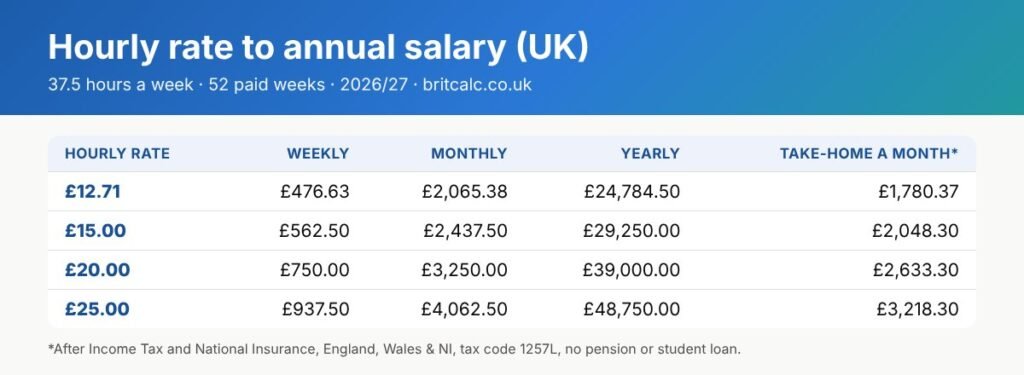
For example, here are common hourly rates converted for a full-time 37.5-hour week with 52 paid weeks. Meanwhile, the take-home figures assume tax code 1257L in England, Wales or Northern Ireland, with no pension or student loan.
| Hourly rate | Weekly | Monthly | Yearly | Take-home a month |
|---|---|---|---|---|
| £12.71 | £476.63 | £2,065.38 | £24,784.50 | £1,780.37 |
| £13 | £487.50 | £2,112.50 | £25,350.00 | £1,814.30 |
| £15 | £562.50 | £2,437.50 | £29,250.00 | £2,048.30 |
| £18 | £675.00 | £2,925.00 | £35,100.00 | £2,399.30 |
| £20 | £750.00 | £3,250.00 | £39,000.00 | £2,633.30 |
| £25 | £937.50 | £4,062.50 | £48,750.00 | £3,218.30 |
| £30 | £1,125.00 | £4,875.00 | £58,500.00 | £3,707.28 |
Salary to hourly rate
| Annual salary | Hourly (37.5 hrs) | Hourly (40 hrs) | Monthly |
|---|---|---|---|
| £25,000 | £12.82 | £12.02 | £2,083.33 |
| £30,000 | £15.38 | £14.42 | £2,500.00 |
| £35,000 | £17.95 | £16.83 | £2,916.67 |
| £40,000 | £20.51 | £19.23 | £3,333.33 |
| £50,000 | £25.64 | £24.04 | £4,166.67 |
| £60,000 | £30.77 | £28.85 | £5,000.00 |
Minimum wage rates from April 2026
From 1 April 2026, employers must pay at least these hourly rates (GOV.UK: National Minimum Wage and National Living Wage rates):
| Age or type | Hourly rate from 1 April 2026 | Previous rate |
|---|---|---|
| 21 and over (National Living Wage) | £12.71 | £12.21 |
| 18 to 20 | £10.85 | £10.00 |
| Under 18 | £8.00 | £7.55 |
| Apprentice | £8.00 | £7.55 |
In practice, full-time at 37.5 hours a week, the National Living Wage works out at £24,784.50 a year. Also, the hourly to annual salary calculator warns you if your hourly rate is below the minimum for your age.
Apprentices get the apprentice rate if they’re under 19, or 19 or over and in the first year of their apprenticeship. Otherwise, they get the rate for their age. If you think you’re being underpaid, Acas can give free, confidential advice.
Factors that change your annual salary
- Hours per week. Full-time hours in the UK usually range from 35 to 40. So a salary spread over more hours means a lower hourly rate.
- Paid holiday. Most employers pay staff during holidays, so 52 weeks is right. However, if you’re paid only for hours worked, your yearly total is lower.
- Overtime and shift premiums. These can add a lot to your yearly pay, although only if they’re regular.
- Bonuses and commission. These aren’t part of your hourly rate, so instead add them separately.
- Unpaid breaks. Similarly, if your lunch break is unpaid, don’t count it in your hours.
Holiday pay and paid weeks
Almost all workers have a right to 5.6 weeks of paid holiday a year, which is 28 days for someone working 5 days a week (GOV.UK: holiday entitlement). Employers can include bank holidays in this. Because employers pay holiday, a full-time employee gets paid for all 52 weeks of the year, even though they only work about 46.4 of them.
That’s why this calculator asks for paid weeks rather than worked weeks. Therefore, if you’re a contractor or agency worker who doesn’t get paid for time off, use the number of weeks you actually expect to get paid for.
How take-home pay is estimated
The take-home figure is a yearly estimate. First, it uses the 2026/27 Personal Allowance of £12,570, which falls by £1 for every £2 you earn over £100,000. Next, it charges Income Tax at 20%, 40% and 45% in England, Wales and Northern Ireland (GOV.UK: Income Tax rates), or at the six Scottish rates if you choose Scotland (Scottish Government). Finally, it includes employee National Insurance at 8% between £12,570 and £50,270 and 2% above (GOV.UK: NI rates).
However, it doesn’t include pension contributions, student loan repayments or a non-standard tax code. For those, use our Take Home Pay Calculator, or check a single payslip with the PAYE Calculator.
Common mistakes with an hourly to annual salary calculator
- Using 52 weeks when holidays are unpaid. As a result, this overstates your yearly pay by about 11%.
- Counting unpaid breaks as hours. A 9-to-5 day with an unpaid hour for lunch is 7 paid hours, not 8.
- Dividing a monthly salary by 4. A month is about 4.33 weeks, so dividing by 4 makes your weekly pay look too high. Instead, multiply by 12 and divide by 52.
- Comparing gross with net. Job adverts show gross pay, so compare take-home pay to see the real difference.
- Forgetting that overtime isn’t guaranteed. Only include overtime you can rely on.
Who should use this hourly to annual salary calculator?
In short, this hourly to annual salary calculator is useful for anyone comparing an hourly job with a salaried one, part-time workers working out their yearly income, people checking they’re paid at least the minimum wage, and employers setting pay for a new role.
Tips for accurate hourly to annual salary calculator results
- Use your contracted hours, not the hours you happen to work in a busy week.
- Check whether your hourly rate already includes holiday pay. For instance, some agency and zero-hours contracts “roll up” holiday pay into the hourly rate.
- Add regular overtime only, using the rate in your contract.
- Finally, check your take-home figure against a real payslip, which may include pension and student loan deductions.
Frequently asked questions
How do I convert an hourly rate to an annual salary?
Multiply your hourly rate by the hours you work each week, then by the number of paid weeks in a year (usually 52). For example, £15 × 37.5 hours × 52 weeks = £29,250 a year.
How many working hours are there in a year in the UK?
For a 37.5-hour week with 52 paid weeks, there are 1,950 paid hours a year. For a 40-hour week, there are 2,080. Hours actually worked are lower, because paid holiday is included.
£12.71 an hour is how much a year?
At 37.5 hours a week and 52 paid weeks, the April 2026 National Living Wage of £12.71 an hour is £24,784.50 a year, or about £2,065 a month before tax.
How do I work out my hourly rate from my salary?
Divide your annual salary by your yearly paid hours. On 37.5 hours a week, divide by 1,950. So £30,000 a year is about £15.38 an hour.
Should I use 52 weeks or less?
Use 52 if you get paid for your holidays, which is the case for most employees. If you only get paid for weeks you work, use the number of weeks you expect pay for, such as 46.4 if all your statutory holiday is unpaid.
Does the hourly to annual salary calculator work out tax?
Yes. It shows an estimate of yearly take-home pay after Income Tax and National Insurance for 2026/27. It does not include pension or student loan deductions.
Final thoughts
Converting between an hourly rate and a salary is simple maths. Even so, the details matter: paid holiday, unpaid breaks and overtime can all change the answer by thousands of pounds a year. So use the hourly to annual salary calculator above with your own hours, and then check the take-home figure to see what really lands in your account.
Other calculators you might find useful: the Take Home Pay Calculator, the PAYE Calculator, the National Insurance Calculator and the UK Income Tax Calculator.
Sources: National Minimum Wage rates; Holiday entitlement; Income Tax rates; Scottish Income Tax 2026 to 2027; National Insurance rates.
These figures are estimates using 2026/27 rates and the assumptions above. They’re not financial or tax advice. Your actual pay depends on your contract and payroll.