What this mortgage affordability calculator does
This mortgage affordability calculator gives you a quick estimate of how much you could borrow for a mortgage in the UK, the property price that would let you buy, and what the monthly repayments would be. Enter your income, deposit, any monthly debt payments, an interest rate and a mortgage term, and it shows your likely borrowing at different income multiples.
In addition, it goes one step further than a simple “times your salary” figure. For example, it estimates your take-home pay, so you can see how much of it the mortgage would use. It also shows a stress test of what you’d pay if rates rose by 3 percentage points. That way, you can judge whether you could afford the repayments, not just whether a lender might offer the loan.
How to use the mortgage affordability calculator
- Choose whether you’re buying alone or with someone. For a joint mortgage, add the second person’s income.
- Enter your gross yearly income. Include regular overtime or bonuses only if you get them every year, because lenders may count only part of them.
- Then add your deposit. This is the cash you’ll put towards the home.
- Enter your monthly debt payments. Include personal loans, car finance and credit card repayments.
- Choose an income multiple. 4.5× is typical. Pick 4× for a cautious estimate, or higher multiples to see what specialist lenders might offer.
- Finally, set the interest rate and term. By default it uses 6%, close to the average fixed rate in October 2026, over 25 years.
How the mortgage affordability calculator works
First, the calculator takes your yearly debt payments away from your income. Then it multiplies what’s left by the income multiple:
Maximum mortgage = (total income − monthly debt payments × 12) × income multiple
Maximum property price = maximum mortgage + deposit
Next, it works out the monthly repayment on a capital and interest (repayment) mortgage using the standard formula:
Monthly repayment = L × r ÷ (1 − (1 + r)−n)
In this formula:
- L: the loan amount (your mortgage).
- r: the monthly interest rate, which is the yearly rate ÷ 12. For example, 6% a year is 0.5% a month.
- n: the number of monthly payments, so 25 years is 300 payments.
- Income multiple: how many times your income a lender might lend. Lenders call the result your loan-to-income ratio (LTI).
- Loan to value (LTV): the mortgage as a percentage of the property price. In general, a smaller LTV (bigger deposit) gets you a better rate.
Taking debts off your income is, in effect, a simple way to reflect how lenders treat existing borrowing. In reality, however, each lender runs its own model, so treat the result as a guide rather than a promise.
Mortgage affordability calculator examples
Single buyer earning £40,000
| Step | Working | Amount |
|---|---|---|
| Income | £40,000 | |
| Mortgage at 4.5× | £40,000 × 4.5 | £180,000 |
| Plus deposit | £25,000 | |
| Maximum property price | £180,000 + £25,000 | £205,000 |
| Loan to value | £180,000 ÷ £205,000 | 87.8% |
| Monthly repayment | 6% over 25 years | £1,159.74 |
| If rates rose to 9% | Stress test | £1,510.55 |
Take-home pay on £40,000 is about £2,693 a month in England, Wales or Northern Ireland, so the repayment would take about 43% of it. That’s a lot. As a result, a lender may offer less once it looks at your spending, or you might choose to borrow less.
Couple earning £40,000 and £30,000 with car finance
Together they earn £70,000. However, they also pay £250 a month on car finance. So the calculator uses £70,000 − £3,000 = £67,000. At 4.5× that gives £301,500. Then, with a £30,000 deposit, they could look at homes up to £331,500, at 91% LTV.
At 6% over 25 years, the repayment is £1,942.57 a month, or about 41% of their combined take-home pay of £4,786.60. Meanwhile, if rates rose to 9%, it would be £2,530.18.
How the term changes the repayment
Borrowing £180,000 at 6% costs £1,159.74 a month over 25 years, £1,079.19 over 30 years and £1,026.34 over 35 years. However, total interest rises from £167,922 to £208,508 and then £251,063. A longer term makes each payment smaller but the mortgage much more expensive overall.
How much can I borrow? Mortgage affordability calculator salary table
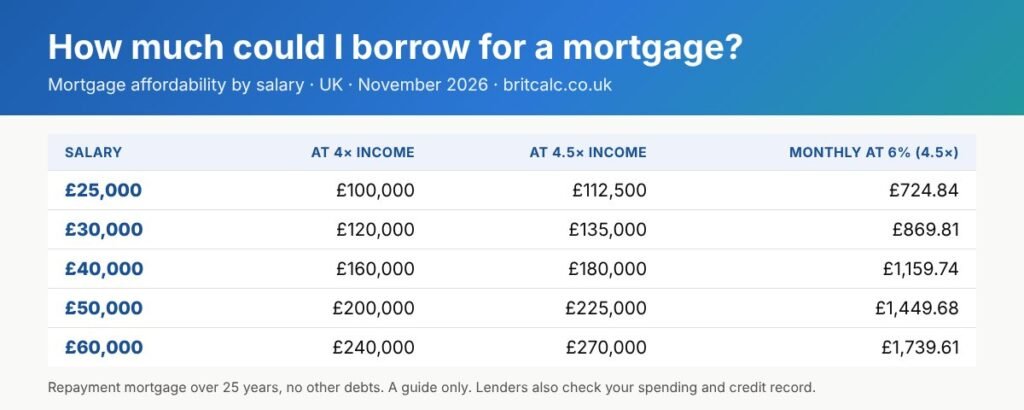
For example, here’s a rough guide to mortgage borrowing for a single buyer with no other debts, using a 6% rate over 25 years.
| Salary | At 4× income | At 4.5× income | Monthly repayment (4.5×) | Share of take-home pay |
|---|---|---|---|---|
| £25,000 | £100,000 | £112,500 | £724.84 | 40.4% |
| £30,000 | £120,000 | £135,000 | £869.81 | 41.6% |
| £40,000 | £160,000 | £180,000 | £1,159.74 | 43.1% |
| £50,000 | £200,000 | £225,000 | £1,449.68 | 44.0% |
| £60,000 | £240,000 | £270,000 | £1,739.61 | 46.0% |
| £80,000 | £320,000 | £360,000 | £2,319.49 | 48.9% |
Notice that the share of take-home pay actually rises with salary. That’s because higher earners pay more tax, so their take-home pay doesn’t rise as fast as their gross salary.
How the interest rate changes the repayment
| Interest rate | Monthly repayment on £180,000 over 25 years |
|---|---|
| 4% | £950.11 |
| 5% | £1,052.26 |
| 6% | £1,159.74 |
| 7% | £1,272.20 |
Income multiples and lending rules in 2026
Most lenders cap borrowing at about 4 to 4.5 times your income. MoneyHelper says the most you can borrow is “usually capped” at four-and-a-half times your annual income (MoneyHelper). However, some lenders go higher for certain buyers. For instance, in 2025 Nationwide offered eligible first-time buyers up to 6 times income through its Helping Hand mortgage (Nationwide, May 2025).
There’s also a Bank of England rule on high loan-to-income mortgages, which it defines as 4.5 times income or more. From 28 October 2026, individual lenders are no longer limited to 15% of their own new mortgages at that level. However, the 15% limit still applies across the market as a whole (Bank of England PS19/26). In practice, more borrowers may get offers of 4.5× or more, although it isn’t guaranteed.
Mortgage rates and the mortgage affordability calculator stress test
Fixed mortgage rates have risen during 2026. In early October, Moneyfacts reported the average five-year fixed rate at 6% and the average two-year fixed rate at 5.98% (Moneyfacts, 5 October 2026). Rates change often, so always check current deals before you rely on any figure.
Lenders also test whether you could still pay if rates went up. Each lender sets its own stress rate. Similarly, the calculator adds 3 percentage points to your rate as a simple check. Therefore, if that higher payment would leave you short each month, consider borrowing less.
Factors that affect how much you can borrow
- Income type. Lenders treat basic salary as most reliable. By contrast, bonuses, overtime and self-employed income may only partly count.
- Debts and credit cards. Monthly debt payments reduce what you can borrow. Also, even unused credit card limits can matter to some lenders.
- Spending. Childcare, school fees, travel costs and other regular bills all affect affordability checks.
- Credit record. Missed payments or defaults can limit the lenders and rates open to you.
- Deposit size. A bigger deposit lowers your LTV, which usually means a lower rate and lower repayments.
- Term and age. A longer term lowers payments, but lenders may limit how long the mortgage can run into retirement.
Common mistakes when using a mortgage affordability calculator
- Only looking at the maximum loan. The most a lender will offer isn’t always what you can comfortably afford. So check the repayment against your take-home pay too.
- Forgetting buying costs. Stamp duty, solicitor and survey fees and moving costs all come on top. Use our Stamp Duty Calculator to check the tax.
- Using an old interest rate. A 1 percentage point change in rate can change the repayment by over £100 a month on a typical loan.
- Leaving out small debts. Buy now pay later and car finance payments still count.
- Assuming the fixed rate lasts forever. Most fixed deals end after 2 to 5 years, after which your rate could be higher or lower.
Who should use this mortgage affordability calculator?
In short, this mortgage affordability calculator is useful for first-time buyers setting a budget, home movers checking how far they could go, and couples working out a joint mortgage. It’s also helpful before you speak to a broker, so that you know roughly what to expect.
However, it isn’t a mortgage offer or a credit check. For a decision in principle, a lender or broker will look at your full finances and credit record.
Tips to improve your mortgage affordability
- Pay down or clear loans and credit cards before you apply.
- Save a bigger deposit. Getting below thresholds such as 90% or 85% LTV can unlock better rates.
- Also, check your credit report for mistakes and make sure you’re on the electoral roll.
- Compare the whole market through a mortgage broker, since lenders’ income multiples and stress rates differ.
- Finally, keep spending steady in the months before you apply, because lenders may ask for recent bank statements.
Frequently asked questions
How much can I borrow for a mortgage on £40,000?
At 4.5 times income, around £180,000, or £160,000 at 4 times. With a £25,000 deposit that means a property up to about £205,000. At 6% over 25 years, the repayment on £180,000 is £1,159.74 a month.
Is 4.5 times salary the maximum mortgage?
For most lenders, yes, roughly. Some lenders offer 5 to 6 times income to higher earners, certain professions or eligible first-time buyers. From 28 October 2026, individual lenders have more room to do this, but the Bank of England still limits high loan-to-income lending across the market.
Do lenders count both incomes on a joint mortgage?
Yes. Most lenders add both incomes together and apply the income multiple to the total, after looking at both people’s debts and spending.
How do debts affect how much I can borrow?
Monthly debt payments reduce the income a lender has left to cover a mortgage. In this calculator, every £100 a month of debt cuts your borrowing by £5,400 at 4.5 times income.
What is a mortgage stress test?
It is a check of whether you could still afford the repayments if interest rates rose. Each lender sets its own stress rate. This calculator shows the repayment if your rate rose by 3 percentage points.
Is the mortgage affordability calculator a mortgage offer?
No. It is a guide based on simple income multiples and your own figures. A lender or broker will check your full income, spending and credit record before giving a decision in principle or a mortgage offer.
What deposit do I need to buy a house?
Most UK lenders ask for at least 5% of the price, and only a few specialist mortgages lend 100%. A bigger deposit usually gets you a lower interest rate.
Final thoughts
A lender’s maximum loan is only half the story. Equally important is whether the monthly repayment fits your budget today and if rates rise. Use the mortgage affordability calculator above to test different deposits, terms and rates. After that, speak to a mortgage broker or lender for a decision in principle before you start house hunting.
Other calculators you might find useful: the Mortgage Repayment Calculator, the Stamp Duty Calculator, the Take Home Pay Calculator and the Savings Calculator for building your deposit.
Sources: MoneyHelper: how much can you afford to borrow; Bank of England PS19/26 high LTI lending; Moneyfacts average fixed rates; Nationwide affordability changes.
These figures are estimates based on the assumptions above. They’re not financial advice or a mortgage offer. Your home may be repossessed if you do not keep up repayments on your mortgage.